


MESH NETWORKS
understanding Mesh networks: A Comprehensive Guide
For many years, mesh Wi-Fi was used exclusively in businesses where secure networks were critical. Recently, mesh Wi-Fi has entered the consumer market, providing access to secure, high-speed, and long-range Wi-Fi networks for homes.
In this post, we’ll explain what mesh Wi-Fi is, who it’s for, and some great options to get you started.

Who needs mesh wifi?
Mesh Wi-Fi is designed for those with weak or incomplete Wi-Fi coverage in their home or workplace, as well as people who want an uncomplicated, easy-to-set-up Wi-Fi system.
Traditional routers have a limited range and often cannot fully cover multi-story or large homes. If you live or work in a property that’s 3,000 sq. ft. or larger, has two stories or more, interior brick walls, or an unusual layout, a mesh Wi-Fi router would be beneficial.

One Network for Your Entire Home
With a Mesh Wi-Fi router, you can skip signing into a new network every time you go upstairs and stay connected to a single sturdy network no matter where you are. Mesh technology is smart and intuitive, letting you stay online even if one of your mesh nodes fails.

Stable Long Range Connectivity
With a mesh router, you can get a powerful and stable connection no matter where you are in your home. Because each mesh node piggybacks off the other nodes signal, you can get powerful Wi-Fi whether you’re at the top of the stairs or the bottom of the basement.

Easy Setup and Management
Most mesh routers on the market today come with easy network setup and management, allowing you to toggle network settings, check speeds, and enact parental controls.

Control Your Smart Home
Some mesh routers are so advanced that they function as a WiFi router and a smart hub, connecting your Zigbee, Bluetooth and Wi-Fi devices and enabling you to manage all your smart devices through the app.
What’s the difference between Mesh Wi-Fi and a Range Extender?
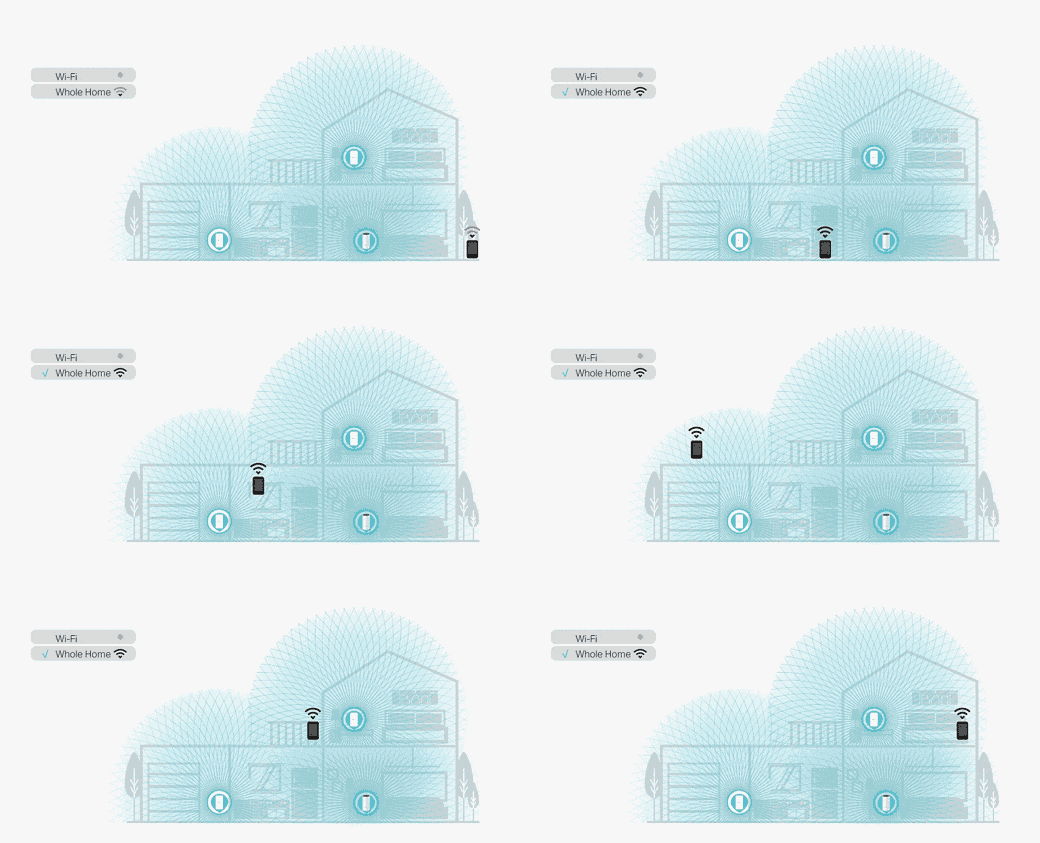

While mesh Wi-Fi and Range extenders might appear to have the same functionality, there are some key differences.
Mesh Wi-Fi devices comes with roaming protocols (to keep you on the same network) and mesh technologies such as self-healing and adaptive routing to keep your network stable.
Range extenders require you to sign on to a new network manually in order to maintain a strong connection once you’re far enough away from your router.
Most range extenders are set up under different networks; but with mesh networks there are no other networks to worry about. While each mesh node essentially functions as its own router, range extenders are merely duplicating the routers original signal.
Mesh Wi-Fi is faster and more efficient at delivering a Wi-Fi signal than a range extender.

One Name. One Password
Mesh WiFi allows you to sign into your network with just one network name and one password to receive seamless WiFi throughout your home.

Seamless Roaming
Seamless roaming allows you to stay connected to your network no matter where you go in your home. Switching from one mesh node to another is so smooth that it’s unnoticeable even when you’re streaming.

Adaptive Routing
Mesh Wi-Fi routers use adaptive routing to automatically choose the best configuration and band for your data, so that you’re always getting the fastest possible speeds.

Self-Healing
In the event that one of your mesh Wi-Fi nodes goes down, your Mesh Wi-Fi network will automatically reroute data to make sure you stay online.
